How windy is too windy to fly a drone?
It's the question almost every new pilot asks, and the honest answer is that it depends. It depends on your drone, on how gusty the wind is, and on how high you fly. Here's how to put a number on it for the way you fly.
Start with your drone's rating
Most drone spec sheets list a maximum wind speed resistance. It's often given in meters per second, so multiply by 2.24 to get miles per hour.
Treat that number as a ceiling, not a target. It's the most your drone is built to handle, with no margin left for a sudden gust, a long trip home, or a battery that's running low.
In Flyby's Hangar, choose your drone's model and its published Wind Rating fills in, or enter it yourself for a custom drone. Flyby then checks the wind against whichever is lower: your own limit or your drone's rating.
Then pick your own limit
Your limit should sit comfortably below your drone's rating, and exactly where depends on you. Flyby's Pilot Limits start from three profiles:
- Careful: 10 mph wind and 16 mph gusts. A good place to start if you're new.
- Standard: 15 mph wind and 22 mph gusts.
- Flexible: 20 mph wind and 30 mph gusts, for experienced pilots.
You can adjust any of them. Move up as you get a feel for how your drone handles a breeze.
Gusts matter more than the average
The wind speed in a forecast is the steady, or sustained, wind. Gusts are short bursts above it, and they're what push a drone off its line.
The gap between the two tells you how rough the air is. Wind at 10 mph gusting to 12 is smooth. Wind at 10 mph gusting to 25 is choppy, even though the average is the same. Gusts matter most near trees and buildings, and when you're landing.
Flyby scores gusts separately from steady wind and shows the spread between them, so a gusty hour can't hide behind a calm average.
The wind up there isn't the wind down here
Forecasts usually give the wind at 10 meters, about 33 feet, above the ground. Higher up, it's usually stronger, because trees, buildings, and the ground itself slow down the air closest to them.
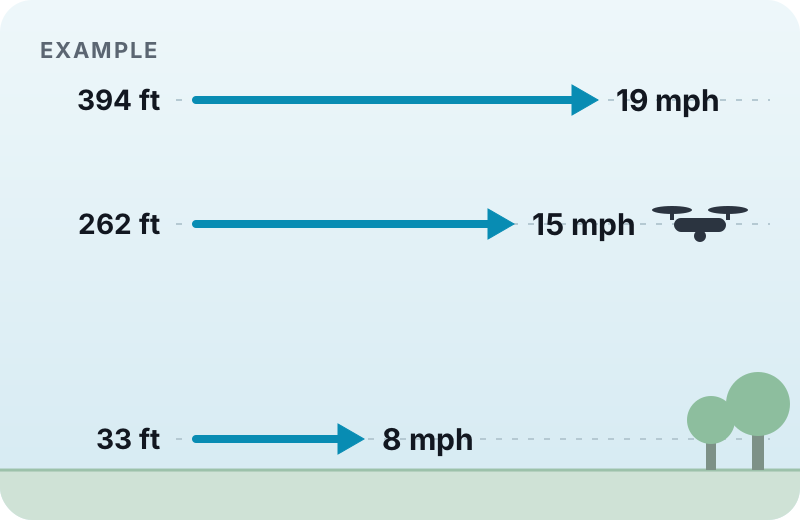
Calm mornings can fool you. On clear, still nights, the air near the ground settles, but the wind a few hundred feet up can keep blowing. You launch in calm air and find a stiff breeze at your flying height.
Flyby forecasts wind at 33, 262, and 394 feet. Set the height you usually fly in Pilot Limits, and Flyby checks your wind limit against whichever is stronger: the wind at the surface or the wind at your height. These are modeled forecasts, so treat them as a guide rather than a reading from the air.
Plan the trip home
On a windy day, fly the first leg into the wind. Then the wind helps carry you home when your battery is at its lowest. Fly out with the wind at your back, and you'll be fighting a headwind on the way back.
Leave extra battery, too. A drone holding its place or pushing into the wind works harder, and an automatic return home takes longer into a headwind.
In Flyby, turn on Use Mission Heading in Pilot Limits and set your outbound heading. Flyby then shows the headwind, tailwind, and crosswind you'll meet on the way out.
Check the wind at your launch spot
A forecast is a starting point. Before you launch, look around. The National Weather Service's Beaufort scale describes what each wind speed looks like on land:
- 8 to 12 mph: leaves and small twigs in constant motion, and a light flag extends.
- 13 to 18 mph: dust and loose paper blow around, and small branches move.
- 19 to 24 mph: small trees in leaf begin to sway.
- 25 to 31 mph: large branches move, and umbrellas are hard to use.
Watch for places where the wind does strange things. It speeds up over ridges and between buildings, and it tumbles into gusty eddies behind them.
After takeoff, hover a few feet up for a moment. If the drone drifts, tilts hard to hold its place, or your drone's app warns about strong wind, land and wait.
A quick checklist
- Know your drone's wind rating, and keep your limit well below it.
- Look at the gusts and the spread, not just the average.
- Check the wind at the height you'll fly.
- Fly the first leg into the wind, and leave extra battery.
- Confirm what you see at the field before you commit.
Flyby rolls all of this into a single number. What shapes your Fly Score explains how.