What shapes your Fly Score
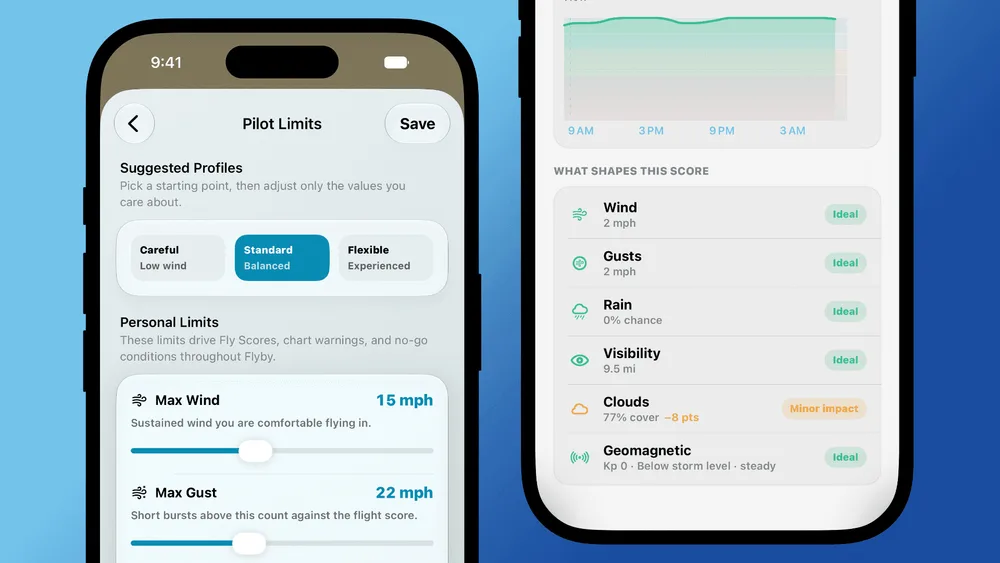
Fly Score rates flying conditions from 0 to 100 for every hour of the forecast. It's built to show its work: tap your score, and What shapes this score lists each condition, how it reads, and how many points it cost, from Ideal all the way to Flight limiting.
Here's what goes into it, and how to make it fit the way you fly.
What the numbers mean
- 85 to 100, Excellent: plenty of margin. A great window to get up and fly.
- 70 to 84, Good: solid conditions. Check the breakdown for anything worth watching.
- 45 to 69, Caution: borderline. Flyable if you stay close and watch the trend.
- Below 45, Grounded: best to keep your drone packed until conditions settle.
It starts with the weather
Every hour starts at 100. Five conditions take points away, judged against what a typical consumer drone handles well. This part is the same for every pilot.
- Wind: light wind costs nothing. Past about 8 mph it starts to count, and past about 20 mph it counts a lot more. Holding position or flying into the wind uses more battery, which leaves less in reserve for the trip home.
- Gusts: scored separately from steady wind, starting at about 12 mph and climbing faster past 25. A sudden gust can push your drone off its line before it corrects, which matters most near trees, buildings, and people.
- Rain: takes points in proportion to its chance, up to 50 when rain is certain. Most consumer drones aren't built to get wet.
- Visibility: costs points below about 4 miles. Haze, fog, and smoke make it harder to keep your drone in sight, and in the US, Part 107 pilots need at least 3 miles.
- Clouds: take up to 10 points at full cover. Heavy cloud rarely grounds a flight on its own, but it flattens the light.
Space weather
Flyby also reads the Kp index, a 0 to 9 measure of geomagnetic activity from NOAA's Space Weather Prediction Center. Geomagnetic storms can disturb the satellite positioning your drone relies on to hold its place and find its way home.
- Below Kp 5, which is below storm level, it costs nothing.
- From Kp 5, the score loses points, from 2 in a minor storm to 25 in an extreme one.
- From Kp 7, strong storms also cap the score: at most 75 at Kp 7, 60 at Kp 8, and 50 at Kp 9.
A high Kp doesn't mean your drone will lose its fix, but it's a good reason to check position hold before you commit. Kp readings older than 90 minutes are left out of the score.
Then your limits have their say
In Pilot Limits, you set the most wind, gusts, rain chance, and cloud cover you're comfortable with, plus the least visibility. Start from a suggested profile and adjust from there:
- Careful: 10 mph wind, 16 mph gusts, 5 miles of visibility, 10% rain chance, 70% cloud cover.
- Standard: 15 mph wind, 22 mph gusts, 3 miles of visibility, 20% rain chance, 85% cloud cover.
- Flexible: 20 mph wind, 30 mph gusts, 2 miles of visibility, 30% rain chance, 95% cloud cover.
Your limits can only hold the score down. They never push it up.
- Past your wind, gust, rain, or visibility limit, the score can't rise above Caution, however good the rest of the hour looks. The further past, the lower it goes.
- Within a quarter of your wind limit, the score loses 5 points.
- More cloud than you like costs 6 points.
That's deliberate. A Flexible profile can't make a stormy afternoon look great, and a Careful one still flags the hours you'd rather skip.
Your drone counts too
Each aircraft in your Hangar has a Wind Rating, its published wind resistance. If that's lower than your wind limit, Flyby checks the wind against your drone's rating instead, with a little extra room for gusts.
Wind where you actually fly
Wind usually gets stronger with height, because the ground slows the air closest to it. A calm launch spot can sit under a much brisker wind a few hundred feet up.
In Pilot Limits, choose the height you usually fly at: 33, 262, or 394 feet. Flyby uses 262 until you pick one. When there's a wind-at-height forecast for that hour, your wind limit is checked against whichever is stronger: the wind at the surface or the wind at your height. What shapes this score shows both.
Wind at height only counts through your wind limit. It costs nothing while it's comfortably below, takes a few points as it gets close, and caps the score once it's over.
How sure the score is
Alongside the score, a confidence label tells you how fresh and complete the data behind it is. It isn't a measure of forecast accuracy.
- High confidence: the weather was updated in the last 30 minutes, gust data is available, and the Kp reading is current.
- Moderate confidence: the weather is 30 minutes to 2 hours old, gust data is missing, or the Kp reading isn't current.
- Limited confidence: the weather is more than 2 hours old or unavailable. Refresh before you rely on it.
After dark
Calm weather at night still gets a score, so you can see it. But when Flyby picks a best window for you, it only chooses from daylight and civil twilight.
Getting the most from it
- Read the reasons, not just the number. Two hours can share a score for different reasons. One held back by cloud is a pleasant flight; one held back by gusts near your limit needs more care.
- Set limits for the drone you fly, and revisit them as your skills grow.
- Check the confidence before you launch, and refresh if it says Limited.
- Treat it as a starting point. Fly Score is an advisory planning aid, not a guarantee or a flight authorization. Check airspace and local rules, and trust what you see at the field. Learn more about flying safely with Flyby.