Golden hour and blue hour for drone photos
The same spot can look flat at noon and stunning an hour before sunset. From the air, a low sun matters even more: long shadows give hills, trees, and buildings a depth you can't get at midday.
Golden hour
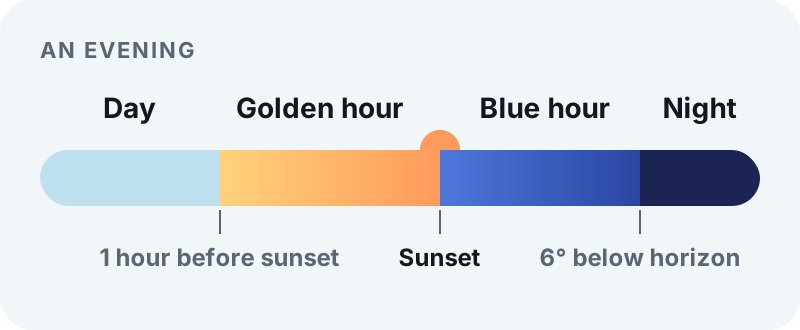
Golden hour is the stretch after sunrise and before sunset when the sun sits low. The light is warm and soft, it comes in from the side, and shadows stretch out across the ground.
Flyby counts golden hour as the hour after sunrise and the hour before sunset, plus any time the sun is less than 6 degrees above the horizon. That last part matters in winter at high latitudes, where the sun can stay low for much of the day.
Blue hour
After the sun sets, the sky turns a deep, even blue, and city lights start to glow. Flyby shows blue hour as civil twilight: from sunset until the sun is 6 degrees below the horizon, and the same stretch before sunrise. Photographers define it in slightly different ways, so treat the times as a guide.
Twilight has its own rules
In the US, flying in twilight or at night comes with lighting rules:
- Part 107 pilots need anti-collision lighting visible for at least 3 statute miles during civil twilight. At night, they need the same lighting plus updated training.
- Recreational flyers who fly at night must follow a community-based organization's safety guidelines, which spell out the lighting you need.
For Part 107, the FAA uses a simple definition of civil twilight: the 30 minutes before official sunrise and the 30 minutes after official sunset, except in Alaska. That window won't always match the blue hour times you see in Flyby, so go by the FAA's definition for the rules. See 14 CFR 107.29 and the FAA's recreational flyer guidance.
Which way to point the camera
The sun's direction changes a shot as much as its height does:
- Front light, with the sun behind the drone, gives bright, even color but flatter shadows.
- Side light brings out texture and long shadows, the classic golden-hour aerial look.
- Backlight, shooting toward the sun, gives silhouettes and glowing edges, and invites lens flare.
Light Direction, on Flyby's Sun tab, maps where the sun rises and sets over your spot. It tells you which way to face for front-lit shots, or into the sun for silhouettes, and how long shadows are compared with the things casting them. It works offline, too.
Check the weather, too
- Clouds: a few high clouds can catch color around sunset, while a solid overcast mutes it.
- Wind: mornings are often calmest at ground level, but the wind a few hundred feet up can still be strong. How windy is too windy? explains why.
- Timing: Flyby's flight windows mark the golden hours, so you can see whether good light and a good Fly Score line up. Save one as a planned flight, and Flyby watches the forecast for meaningful changes.
A quick checklist
- Check the golden hour and blue hour times for your spot.
- Decide on front light, side light, or a silhouette, and find which way to face.
- Look at the clouds and the wind at your flying height.
- If you'll fly into twilight, make sure your lighting meets the rules.